A frame structure can be built two ways: by bending or by welding segments. When is each option more economical and stronger?
A frame, a bracket, or a handrail — all three can be made by bending or welding. The choice depends on batch size, load, and surface requirements.
Tube bending — strengths
- Structural continuity: a bent tube is one piece of material, no weld seam as a weak point.
- Cleaner look: no seam, no grinding, more uniform surface.
- Faster in series: a CNC tube bender produces a part in minutes.
Welding — strengths
- Complex geometry: arbitrary angles and joints.
- Less equipment needed: for prototypes and one-offs, a welding gun is enough.
- Repairable: a damaged segment can be replaced — a bent tube cannot.
How to decide?
In series production, tube bending can in many cases reduce the number of welding operations and the amount of finishing, but the economical solution has to be determined from the part's geometry, material, load, type of use, tooling and quantity.
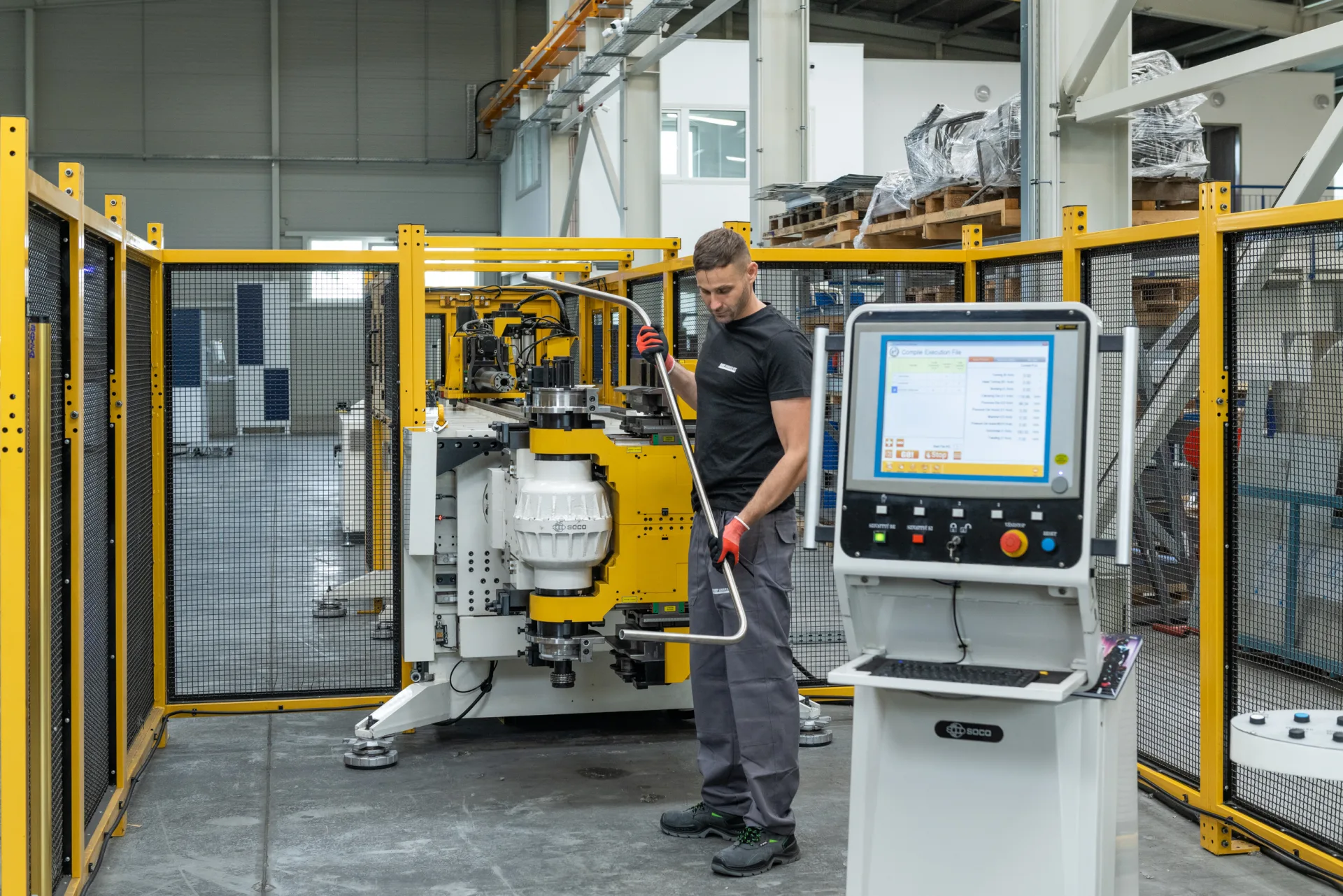
The Linardics SOCO SB-52 CNC tube bender handles bidirectional bending up to 190° on tubes up to Ø50.8 mm — a typical automotive chassis parts dimension.